Hello Everyone!
I can't believe that this is my last "official" day in the lab. I will continue to intern at TGen after graduation, but for now, I am done with my internship and my SRP.
Reflecting on the work I have completed the past few months, I am excited to compile it all together and present the information in the upcoming weeks. I find it shocking how time has passed by so quickly. I had to deal with some challenges and bumps along the way, but the research I have conducted has not left me empty-handed.
When I first started this SRP, I was not exactly sure what my research question was going to be. Will it just be about Rett Syndrome, will it be about the differences between the two kinds of Rett, or will it be more lab based than clinical? There were many things I had to consider. However, once deciding that my research question was more based on the specifics of Rett, I was excited to see how it will go from there.
The following link is to my research presentation. This google slideshow will bring all of the work I have completed together. I'm so happy that I had the opportunity to work in a lab with such great people and to further my experience in the research line.
https://docs.google.com/presentation/d/1Fy27Ah3npeCBHfKeijDIZm9Id8QL0XoVmEpNpcie0zQ/edit#slide=id.g129dbffc0c_1_430
Thank you for sticking with me during this entire process!
Sincerely,
Pooja
Friday, April 22, 2016

Friday, April 15, 2016
Blog 9: 4/15/16
Hello again!
I cannot believe how much time has passed by! I have one more official week left in the lab before my senior research project comes to a close.
This week I have been focusing a lot on my powerpoint. Practice presentations are coming up and soon after that, I have my final presentation.
I have broken up my presentation into a few categories. I initially focus on prior knowledge/ previous research on Rett Syndrome, my own research question, my research process in the lab, and analysis of results/ next steps.
Rett Syndrome is a relatively new field. Labs around the world are working hard to piece together information to find a cure for this disease.
Here is some information on Rett.
Symptoms
Not always detected at first, but a slowing of head growth is the first indication.
Loss of muscle tone.
Loss of hand function
Around 1 to 4 years, social and language skills deteriorate (social anxiety and withdrawal are common)
Uncoordinated breathing, epilepsy
Right now, there is no cure for this syndrome. BUT, it is curable. I am very excited to be a part of a lab that is working towards a cure for this disease.
The C4RCD (Center for Rare Childhood Diseases) website makes a wonderful comparison between the search to identify a unique genome string in a child to the story of a "Brave Zebra". This short story shows how conducting research on rare childhood diseases is like searching for a tiny lifeboat in a vast ocean, a quest that is difficult but proven to be successful in the story.

Thanks for keeping up with me. I can't believe that next week is my last week on this project.
I look forward to seeing how everybody's research comes along within the next few weeks.
Sincerely,
Pooja
I cannot believe how much time has passed by! I have one more official week left in the lab before my senior research project comes to a close.
This week I have been focusing a lot on my powerpoint. Practice presentations are coming up and soon after that, I have my final presentation.
I have broken up my presentation into a few categories. I initially focus on prior knowledge/ previous research on Rett Syndrome, my own research question, my research process in the lab, and analysis of results/ next steps.
Rett Syndrome is a relatively new field. Labs around the world are working hard to piece together information to find a cure for this disease.
Here is some information on Rett.
Symptoms
Not always detected at first, but a slowing of head growth is the first indication.
Loss of muscle tone.
Loss of hand function
Around 1 to 4 years, social and language skills deteriorate (social anxiety and withdrawal are common)
Uncoordinated breathing, epilepsy
Right now, there is no cure for this syndrome. BUT, it is curable. I am very excited to be a part of a lab that is working towards a cure for this disease.
The C4RCD (Center for Rare Childhood Diseases) website makes a wonderful comparison between the search to identify a unique genome string in a child to the story of a "Brave Zebra". This short story shows how conducting research on rare childhood diseases is like searching for a tiny lifeboat in a vast ocean, a quest that is difficult but proven to be successful in the story.
Thanks for keeping up with me. I can't believe that next week is my last week on this project.
I look forward to seeing how everybody's research comes along within the next few weeks.
Sincerely,
Pooja
Friday, April 8, 2016
Blog 8: 4/8/16
Hello again,
So this week went by slowly and a little different than normal.
I wasn't able to go in everyday since I was out of town for some time of the week and at school, meeting with a few teachers to update them on my busy schedule of this final trimester!
This week was slow because I was having trouble yielding successful results. I tried to cast a gel twice as big as the normal size I use. Unfortunately, I used the wrong casting tray and ended up messing up the gel and thereby losing a few samples. But it's no problem since today I am re-doing those samples! So far, I have received successful results!
As the SRP timeline is coming to a close, I find myself busy with more work than usual. Along with the work I do at TGen, the time has come for me to begin working on my presentation as well. Practice Presentations start soon and after that, the final presentations begin!
Although I am very excited to give a conclusive summary of my work the past 8 weeks, I have a lot to do before I am ready to present.
Thank you for sticking with me during this research project!
Pooja
So this week went by slowly and a little different than normal.
I wasn't able to go in everyday since I was out of town for some time of the week and at school, meeting with a few teachers to update them on my busy schedule of this final trimester!
This week was slow because I was having trouble yielding successful results. I tried to cast a gel twice as big as the normal size I use. Unfortunately, I used the wrong casting tray and ended up messing up the gel and thereby losing a few samples. But it's no problem since today I am re-doing those samples! So far, I have received successful results!
As the SRP timeline is coming to a close, I find myself busy with more work than usual. Along with the work I do at TGen, the time has come for me to begin working on my presentation as well. Practice Presentations start soon and after that, the final presentations begin!
Although I am very excited to give a conclusive summary of my work the past 8 weeks, I have a lot to do before I am ready to present.
Thank you for sticking with me during this research project!
Pooja
Sunday, April 3, 2016
Blog 7: 3/29/16
Hello Everyone!
Sorry I didn't post last week. I took the week off as my spring break.
However, after a well-rested week, I couldn't wait to come back to the lab and start my work again.
On Monday, I cast a gel on PCR samples that were run over the weekend by another intern. The samples turned out quite well except for the last few. Another thing I did on Monday involved a different mice species. These species are Naidu1 crossed with TSC. Naidu1 are the mice used when studying Rett Syndrome. TSC is a multi-system genetic disease called tuberous sclerosis that causes benign tumors to grow in the brain and other vital organs like the kidneys, heart, eyes, lungs, and skin. The reason these two mice species were crossed is because TSC activates MTOR pathways, which increases cell growth and metabolism while Rett Syndrome lacks this activation. This allows us to study Rett in species slightly easier. With these samples, I followed a new PCR protocol with new primers and ran a gel. It did not show up too clearly but that can be a direct result of the uniformity failure in the PCR machine itself.
Today, I ran a gel on the samples from yesterday and then uploaded another set of samples into the PCR. However, this time I followed my usual old protocol since these samples were just Naidu1. I ran the gel on these samples but did not have time to image them so I am not 100% it worked.\
Unfortunately, I will not be going into the internship for the rest of the week since I will be doing a few college visits the end of this week and the end of next. However, any work that I will be able to analyze on my computer or work on such as my article, I will definetely be doing so.
That's it for this week!
Thanks,
Pooja
Sorry I didn't post last week. I took the week off as my spring break.
However, after a well-rested week, I couldn't wait to come back to the lab and start my work again.
On Monday, I cast a gel on PCR samples that were run over the weekend by another intern. The samples turned out quite well except for the last few. Another thing I did on Monday involved a different mice species. These species are Naidu1 crossed with TSC. Naidu1 are the mice used when studying Rett Syndrome. TSC is a multi-system genetic disease called tuberous sclerosis that causes benign tumors to grow in the brain and other vital organs like the kidneys, heart, eyes, lungs, and skin. The reason these two mice species were crossed is because TSC activates MTOR pathways, which increases cell growth and metabolism while Rett Syndrome lacks this activation. This allows us to study Rett in species slightly easier. With these samples, I followed a new PCR protocol with new primers and ran a gel. It did not show up too clearly but that can be a direct result of the uniformity failure in the PCR machine itself.
Today, I ran a gel on the samples from yesterday and then uploaded another set of samples into the PCR. However, this time I followed my usual old protocol since these samples were just Naidu1. I ran the gel on these samples but did not have time to image them so I am not 100% it worked.\
Unfortunately, I will not be going into the internship for the rest of the week since I will be doing a few college visits the end of this week and the end of next. However, any work that I will be able to analyze on my computer or work on such as my article, I will definetely be doing so.
That's it for this week!
Thanks,
Pooja
Friday, March 18, 2016
Blog 6: 03/18/16
Hello Everyone!
This week, I continued the procedures that I have been following the past few weeks.
My samples have been working, which means that I have been able to genotype more of the unknown DNA. So far there has been a good mixture of mutant and wild type DNA. Although I have been conducting these same procedures for some time now, there are still many samples left to go through.
Today, I went into the lab a little bit early to work with the zebra fish. Another intern and I met on the fourth floor of TGen and went ahead to practice one more time on the microinjections.
The steps for working with zebra fish are as follows!
1) A breeding pair tank should have been made the night before so the first thing I will do is remove the barrier between the male and female fish.
2) While the fish are nesting, the other intern and I prepared the other materials. Since we were just practicing, we were only going to inject a dye with water into the fish eggs. Once this was prepared, we uploaded 1.5 microliters into a needle and attached the needle to an injection. The needle is very very thin so we had to be careful with handling it.
 Unfortunately, we did actually break the first needle tip so we followed the procedure one more time with a second one.
3) We checked on the fish to see if there were eggs on the bottom of the tank. Since there were, we collected those eggs and put them in a gel petri dish.
4) In this step, we had to orient the eggs so that the cell was lying on the left side.
5) Once all of this was ready to go, we injected the egg with the dye. It looked like this.

The only difference is we injected our dye into the yolk, which is the dark puffy grey area on the left side of the cell.
I'm really happy I was able to practice the injections today so I can actually start the microinjections soon. Although this doesn't have much to do with my senior research project, I am happy to help the lab in whichever way possible.
I can't wait to hear how everyone else's weeks went.
Talk to you soon!
Pooja
This week, I continued the procedures that I have been following the past few weeks.
My samples have been working, which means that I have been able to genotype more of the unknown DNA. So far there has been a good mixture of mutant and wild type DNA. Although I have been conducting these same procedures for some time now, there are still many samples left to go through.
Today, I went into the lab a little bit early to work with the zebra fish. Another intern and I met on the fourth floor of TGen and went ahead to practice one more time on the microinjections.
The steps for working with zebra fish are as follows!
1) A breeding pair tank should have been made the night before so the first thing I will do is remove the barrier between the male and female fish.
2) While the fish are nesting, the other intern and I prepared the other materials. Since we were just practicing, we were only going to inject a dye with water into the fish eggs. Once this was prepared, we uploaded 1.5 microliters into a needle and attached the needle to an injection. The needle is very very thin so we had to be careful with handling it.
3) We checked on the fish to see if there were eggs on the bottom of the tank. Since there were, we collected those eggs and put them in a gel petri dish.
4) In this step, we had to orient the eggs so that the cell was lying on the left side.
5) Once all of this was ready to go, we injected the egg with the dye. It looked like this.
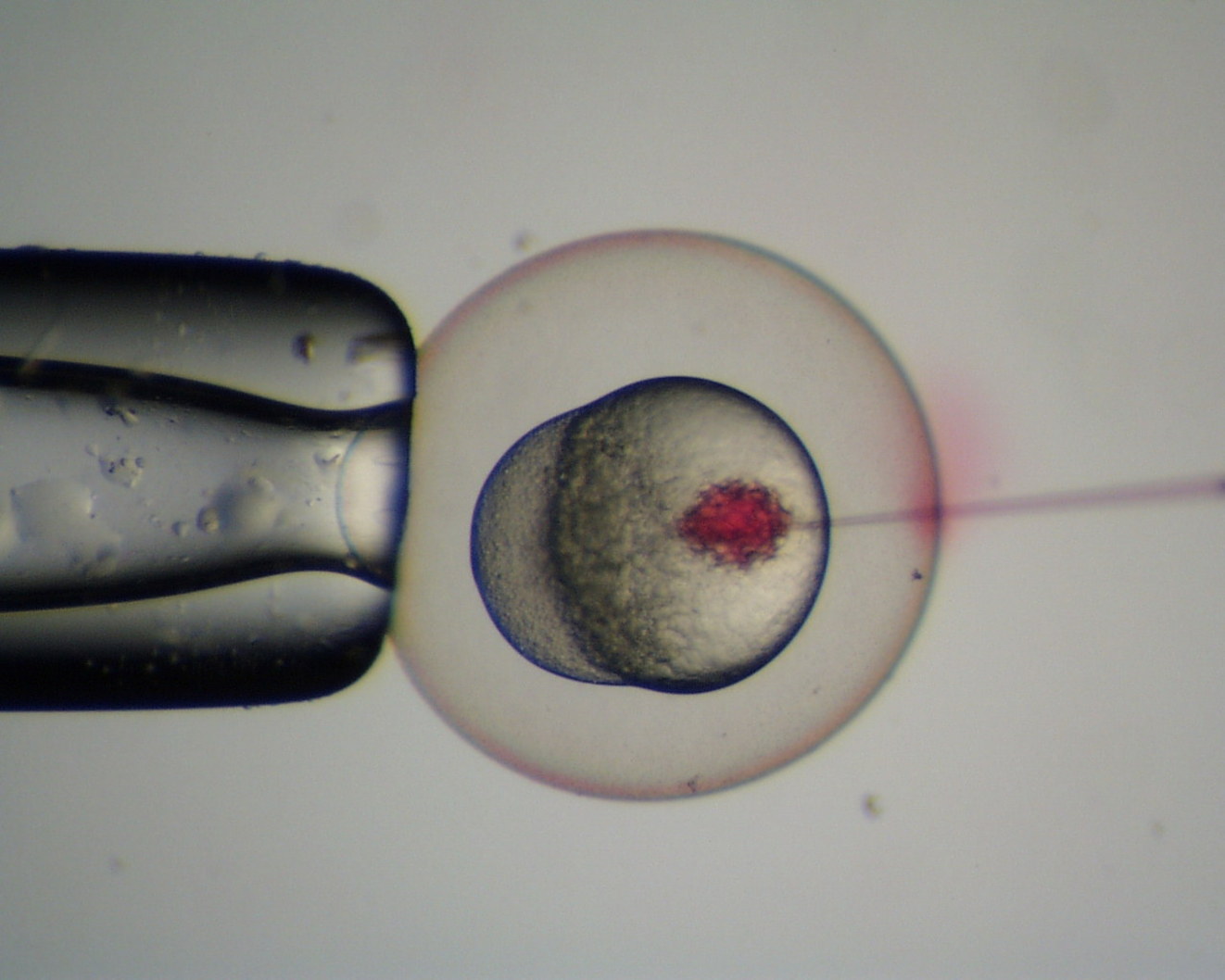
The only difference is we injected our dye into the yolk, which is the dark puffy grey area on the left side of the cell.
I'm really happy I was able to practice the injections today so I can actually start the microinjections soon. Although this doesn't have much to do with my senior research project, I am happy to help the lab in whichever way possible.
I can't wait to hear how everyone else's weeks went.
Talk to you soon!
Pooja
Friday, March 11, 2016
Blog 5: 3/11/16
Hello Hello!
Although technically this week is spring break, I still came into TGen to crank through samples.
So far, the gels have been successful and I have been able to genotype a majority of my samples.
However, I have reached a bump in the road. This entire week, once I have taken the samples out of the PCR machine, it has been saying "Uniformity Failure Service Alpha Soon." Since my mentor is out of town, I researched a little bit on what exactly this means. The uniformity failure in the machine means the power requirements for heating the left and right halves of the sample block are uneven.
This can lead to overheating. So hopefully, by the time my mentor comes back, we will be able to find a solution to our PCR machine problem.
But on the bright side of things, the image below is from a gel I ran earlier this week.

Although technically this week is spring break, I still came into TGen to crank through samples.
So far, the gels have been successful and I have been able to genotype a majority of my samples.
However, I have reached a bump in the road. This entire week, once I have taken the samples out of the PCR machine, it has been saying "Uniformity Failure Service Alpha Soon." Since my mentor is out of town, I researched a little bit on what exactly this means. The uniformity failure in the machine means the power requirements for heating the left and right halves of the sample block are uneven.
This can lead to overheating. So hopefully, by the time my mentor comes back, we will be able to find a solution to our PCR machine problem.
But on the bright side of things, the image below is from a gel I ran earlier this week.

This gel was successful for 9 out of 12 of the samples ran. Although it is slightly difficult to see, the bands on the bottom mean that the sample is Wild Type, the normal genes. The bands on the top is Mutant type, meaning it has the MECP2 mutation, characteristic of Rett Syndrome.
Once I finish running all of my samples and uploading them in an excel spreadsheet, I will be able to carry on to behavioral studies of the mice that do have the mutation.
So a lot of exciting stuff is going to happen in the following weeks!
Thank you for keeping yourself updated with me!
I can't wait to hear how the other SRPs are coming along as well :)
Pooja
Friday, March 4, 2016
Blog 4: 3/4/16
Hello Everyone!
First I wanted to clarify a few things from my last post as I realized I might have been a little unclear. The CITI training that must be completed prior to actually working in the lab with certain resources is associated with the Collaborative Institute Training Initiative. Once I log into my account and fill out some personal information, a list of modules show up on my screen. This is shown in the following picture.
 Although I completed all of these courses last summer, since I logged on with a new account to complete my zebrafish training, the other modules have been listed as "incomplete". After learning from the modules, I take a few quizzes once each section is completed. This ensures that I will be ready to get started in the lab once my training is over.
Now, for the rest of my week, I continued my process of genotyping. I ran PCRs and then gels. Now that we found a successful protocol to conduct these tests, our results have been working quite well!
My mentor will be out of town for the next two weeks, but I will be continuing with my research and hopefully soon, I will be done genotyping the three trays of samples.
Other than that, my week has been the same! I continue to work on my article draft, update my research journal, and see how the samples turn out!
Thanks for keeping up with me!
Pooja
First I wanted to clarify a few things from my last post as I realized I might have been a little unclear. The CITI training that must be completed prior to actually working in the lab with certain resources is associated with the Collaborative Institute Training Initiative. Once I log into my account and fill out some personal information, a list of modules show up on my screen. This is shown in the following picture.

Now, for the rest of my week, I continued my process of genotyping. I ran PCRs and then gels. Now that we found a successful protocol to conduct these tests, our results have been working quite well!
My mentor will be out of town for the next two weeks, but I will be continuing with my research and hopefully soon, I will be done genotyping the three trays of samples.
Other than that, my week has been the same! I continue to work on my article draft, update my research journal, and see how the samples turn out!
Thanks for keeping up with me!
Pooja
Friday, February 26, 2016
Blog 3: 2/26/16
Hi Everyone!
I hope your week has been going well!
I have some exciting news.
The gels have finally started to work! My mentor, Sampath Rangasamy, and I developed a new PCR Protocol where I tested out four different systems. There were samples that would be mixed with magnesium chloride and a FAST HS dye, without magnesium chloride and FAST HS dye, with magnesium chloride and Robust HS dye, and lastly, without magnesium chloride and Robust HS dye.
Basically, these four different sets allowed me to visualize which system would be the best in producing results for genotyping when I would upload the PCR samples into a gel. I found two that worked best: without magnesium chloride and Fast HS dye and with magnesium chloride and Robust HS dye.
Hopefully, once I conduct more samples I will be able to quickly genotype large sets of samples at a time.
I have also begun research alongside my project where I will be working with zebrafish. I have only just begun my training but mainly I will be injecting a dye into the zebrafish eggs to see if in 72 hours, the fish test positive or negative for the gene we are searching for. In the next week I will gain more knowledge on the exact research I will be conducting and will be able to share more details soon.
Other than that, things have been moving at a fast pace! I have started to work on my article with another intern. We are trying to have the rough draft ready by the end of the next month. The article will mainly be following the same guidelines as our poster presentation. Along with the article, I have been spending some time outside of the lab working on CITI Training. In order to work with the fish, I have to complete training on zebrafish online through a bunch of modules.
I am extremely excited for you guys to hear more about the work I'll be doing in the upcoming weeks.
Stay tuned! :)
Pooja
I hope your week has been going well!
I have some exciting news.
The gels have finally started to work! My mentor, Sampath Rangasamy, and I developed a new PCR Protocol where I tested out four different systems. There were samples that would be mixed with magnesium chloride and a FAST HS dye, without magnesium chloride and FAST HS dye, with magnesium chloride and Robust HS dye, and lastly, without magnesium chloride and Robust HS dye.
Basically, these four different sets allowed me to visualize which system would be the best in producing results for genotyping when I would upload the PCR samples into a gel. I found two that worked best: without magnesium chloride and Fast HS dye and with magnesium chloride and Robust HS dye.
Hopefully, once I conduct more samples I will be able to quickly genotype large sets of samples at a time.
I have also begun research alongside my project where I will be working with zebrafish. I have only just begun my training but mainly I will be injecting a dye into the zebrafish eggs to see if in 72 hours, the fish test positive or negative for the gene we are searching for. In the next week I will gain more knowledge on the exact research I will be conducting and will be able to share more details soon.
Other than that, things have been moving at a fast pace! I have started to work on my article with another intern. We are trying to have the rough draft ready by the end of the next month. The article will mainly be following the same guidelines as our poster presentation. Along with the article, I have been spending some time outside of the lab working on CITI Training. In order to work with the fish, I have to complete training on zebrafish online through a bunch of modules.
I am extremely excited for you guys to hear more about the work I'll be doing in the upcoming weeks.
Stay tuned! :)
Pooja
Friday, February 19, 2016
Blog 2: 2/19/16
Hi again!
I just wanted to update you all on this last week.
We are still trying to find the core problem with our gels. I repeated the PCR protocol multiple times this week and casted several gel electrophoresis. However, only once, did a single band show up for one of the samples.
I reviewed past notes and images the lab had to see the procedures that were conducted which led to successful gels and learned that they stopped working when we got new enzymes in the lab. I also found out that when the gels were working, the PCR was set to a different program than the one we currently use.
These are the two possibilities as to why the gels are not working right now. On Monday, the lab will be getting new enzymes and hopefully then, we will be able to genotype our samples.
But I have some exciting news as well!
Last summer, another intern and I held a poster presentation on the research we had conducted over the course of a few months. Now, we are given the chance to write an article on our results. It should be done by the end of the month!
I am excited to begin this new process and to go to the lab on Monday to see how the samples turn out!
Thank you for following me along the journey of this research process!!
Hope you all have a great weekend,
Pooja
I just wanted to update you all on this last week.
We are still trying to find the core problem with our gels. I repeated the PCR protocol multiple times this week and casted several gel electrophoresis. However, only once, did a single band show up for one of the samples.
I reviewed past notes and images the lab had to see the procedures that were conducted which led to successful gels and learned that they stopped working when we got new enzymes in the lab. I also found out that when the gels were working, the PCR was set to a different program than the one we currently use.
These are the two possibilities as to why the gels are not working right now. On Monday, the lab will be getting new enzymes and hopefully then, we will be able to genotype our samples.
But I have some exciting news as well!
Last summer, another intern and I held a poster presentation on the research we had conducted over the course of a few months. Now, we are given the chance to write an article on our results. It should be done by the end of the month!
I am excited to begin this new process and to go to the lab on Monday to see how the samples turn out!
Thank you for following me along the journey of this research process!!
Hope you all have a great weekend,
Pooja
Wednesday, February 17, 2016
Obstacles
Good Morning Everyone!
For the past few days in the lab, we have reached an obstacle in our research. As stated in my previous post, I have cast several gels and have run multiple PCRs. But recently, the gels have not been producing efficient results.
The confusion lies in why. Earlier last week, when I followed the original A140V PCR Protocol and ran the original "Main: A140V-HF Program" (the program that is running on the PCR machine), two gels worked. Now, when I am following that same protocol, I am not reaching conclusive results. My mentor and I have altered the protocol and even the program slightly each day in hopes to find the genotype of the samples.
Today, I will be following the original protocol one more time with a slightly altered PCR program. Fingers crossed for it to work!
Pooja
For the past few days in the lab, we have reached an obstacle in our research. As stated in my previous post, I have cast several gels and have run multiple PCRs. But recently, the gels have not been producing efficient results.
The confusion lies in why. Earlier last week, when I followed the original A140V PCR Protocol and ran the original "Main: A140V-HF Program" (the program that is running on the PCR machine), two gels worked. Now, when I am following that same protocol, I am not reaching conclusive results. My mentor and I have altered the protocol and even the program slightly each day in hopes to find the genotype of the samples.
Today, I will be following the original protocol one more time with a slightly altered PCR program. Fingers crossed for it to work!
Pooja
Friday, February 12, 2016
Blog 1: 2/12/16
Hello all!
Monday morning, February 8th, marked my first day back in the lab at TGen. I was welcomed by several exciting tasks and projects which I will begin to pursue in the next following months.
The day started off with me running a 1.8% agarose gel electrophoresis. Now, I know what you must be thinking, what exactly does this mean or what is the purpose of this gel? A gel electrophoresis separates DNA fragments based off of its size. An electric current then moves the DNA molecules across the gel.

The above image shows what a gel electrophoresis image looks like. The first column of bands is known as the DNA ladder. This is the set that all of the other bands will be compared to in order to genotype the DNA. Using the samples we have in the lab, I ran over 5 gels this week with only 2 being successful. Gels may not work for several reasons: the temperature may be too hot, the enzymes may be degraded, the gel may not have run for a long enough time, etc.
Using a 100 base pair DNA ladder, I was able to genotype several samples distinguishing if they were heterozygous, wild type, or mutant. If heterozygous, two bands will show up in the image. If wild type, there will only be one band on the bottom. And if mutant, there will only be one band on the top, which is exactly what we are searching for and are still yet to find.
Throughout the week, when I was not running a gel, I was running a PCR. Testing about 7-8 samples at a time, I followed the lab's new PCR protocol. After the PCR samples were done, I would upload them into a gel, completing the cycle.
In the next upcoming week, I will be furthering my research project by learning to conduct western blots, by working with mice models and even tissue samples. I will also begin to intern at the Center for Rare Childhood Diseases (C4RCD) where I will see the clinical aspect of the research in the lab. I am very excited to see where this research will take me and to eventually find out more about this severe disease.
Bye for now!
Pooja
Monday morning, February 8th, marked my first day back in the lab at TGen. I was welcomed by several exciting tasks and projects which I will begin to pursue in the next following months.
The day started off with me running a 1.8% agarose gel electrophoresis. Now, I know what you must be thinking, what exactly does this mean or what is the purpose of this gel? A gel electrophoresis separates DNA fragments based off of its size. An electric current then moves the DNA molecules across the gel.

The above image shows what a gel electrophoresis image looks like. The first column of bands is known as the DNA ladder. This is the set that all of the other bands will be compared to in order to genotype the DNA. Using the samples we have in the lab, I ran over 5 gels this week with only 2 being successful. Gels may not work for several reasons: the temperature may be too hot, the enzymes may be degraded, the gel may not have run for a long enough time, etc.
Using a 100 base pair DNA ladder, I was able to genotype several samples distinguishing if they were heterozygous, wild type, or mutant. If heterozygous, two bands will show up in the image. If wild type, there will only be one band on the bottom. And if mutant, there will only be one band on the top, which is exactly what we are searching for and are still yet to find.
Throughout the week, when I was not running a gel, I was running a PCR. Testing about 7-8 samples at a time, I followed the lab's new PCR protocol. After the PCR samples were done, I would upload them into a gel, completing the cycle.
In the next upcoming week, I will be furthering my research project by learning to conduct western blots, by working with mice models and even tissue samples. I will also begin to intern at the Center for Rare Childhood Diseases (C4RCD) where I will see the clinical aspect of the research in the lab. I am very excited to see where this research will take me and to eventually find out more about this severe disease.
Bye for now!
Pooja
Thursday, January 21, 2016
Introduction
Hello fellow student bloggers and internet users! Welcome to my
blog!
My name is Pooja Venugopal and I am a senior at BASIS Scottsdale.
The third trimester of our senior year at BASIS, we are given the
opportunity to pursue a senior research project on a topic of our choice. This
project allows us to conduct research in different settings- whether a lab, a
hospital, a classroom, or even a law office.
For my project, I will be interning in a research lab that I have
worked in the past year at the Center for Rare Childhood Diseases (C4RCD) in the Translational Genomics Research Institute, also known as TGEN. (A link to C4RCD & TGEN's website will be attached at the bottom of this
post.) Under the guidance of Sampath Rangasamy, I will learn more about the pathogenesis of Rett Syndrome, a neurodevelopmental disorder caused by a mutation in a single gene: MECP2. During this project, I will study the cells grown in the lab and mice models in order to understand the biology of the disease. I
will collect DNA samples from mice through tail cuts, upload these samples into
a PCR Machine, which will replicate the DNA hundreds of times, and conduct a
gel electrophoresis which will help me identify the mutant mice and
the normal mice (Wild Type) as well as compare the two models. This research will also lead to behavioral studies. The main hurdle doctors/researchers are facing now is that
they are able to diagnose a patient with Rett syndrome but are unable to find a cure.
Starting on February 8th, I will be working in the lab
5-6 days a week for almost 8 hours every day. Most days I will visit the Center for Rare Childhood Diseases (C4RCD) and study the neurogenetics of classical versus atypical Rett Syndrome.
I couldn't be more excited to continue my research and learn more
about this disease!
Until next time,
Pooja Venugopal
https://www.tgen.org/home/research.aspx#.VqGnbZOAOko
Subscribe to:
Posts (Atom)